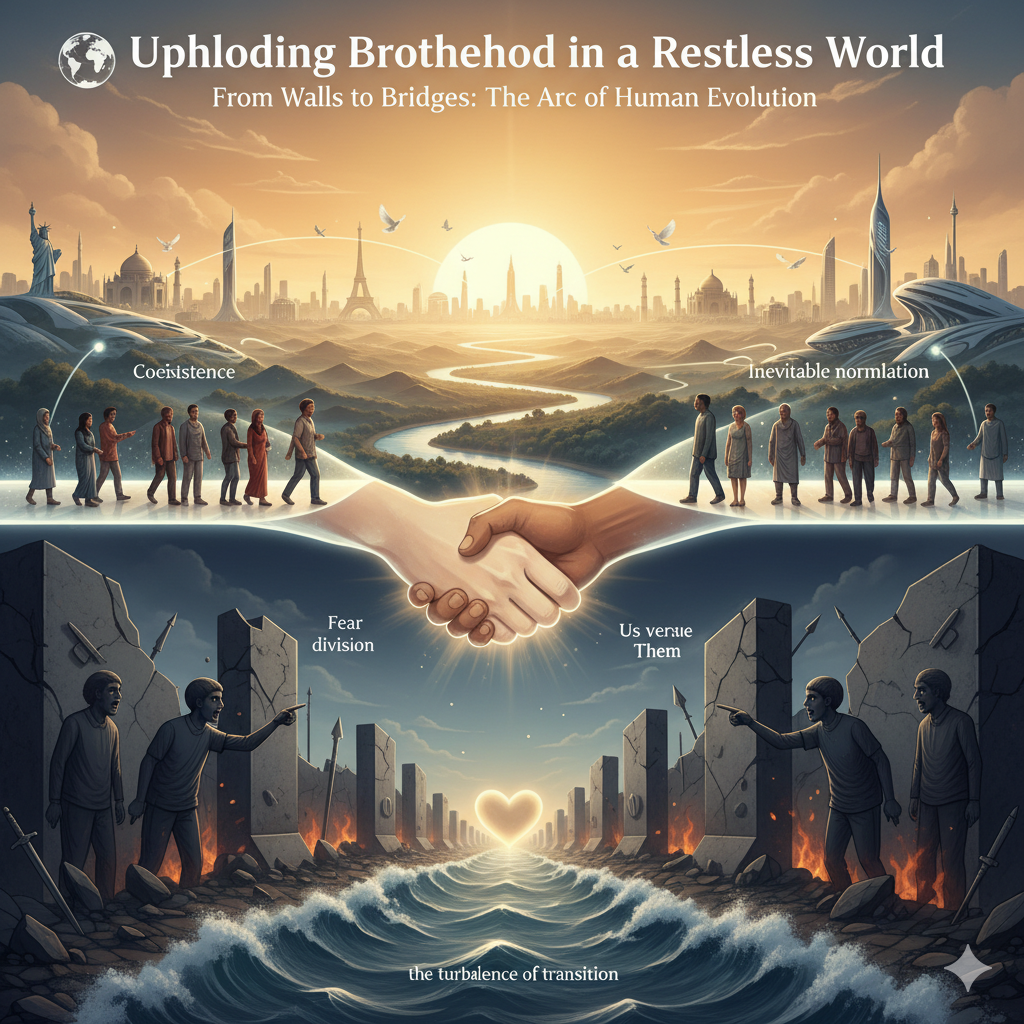
Upholding Brotherhood in a Restless World 🌍🤝
We live in an age of motion—of people, ideas, and identities crossing borders faster than ever before 🚶🏽♂️✈️🚢. Yet, paradoxically, this is also an age of fear. Across continents, migrants are viewed with suspicion, difference is politicized, and the old instinct of “Us versus Them” resurfaces 🔥.
At moments like this, humanity is tested—not by how efficiently we build walls, but by how consciously we uphold brotherhood ❤️. What we are witnessing today is not a collapse of civilization, but the turbulence of transition. History reminds us that every profound shift in human organization is noisy, uncomfortable, and contested 🌊. And yet, again and again, humanity finds balance.
When Humans Rarely Met 🌱
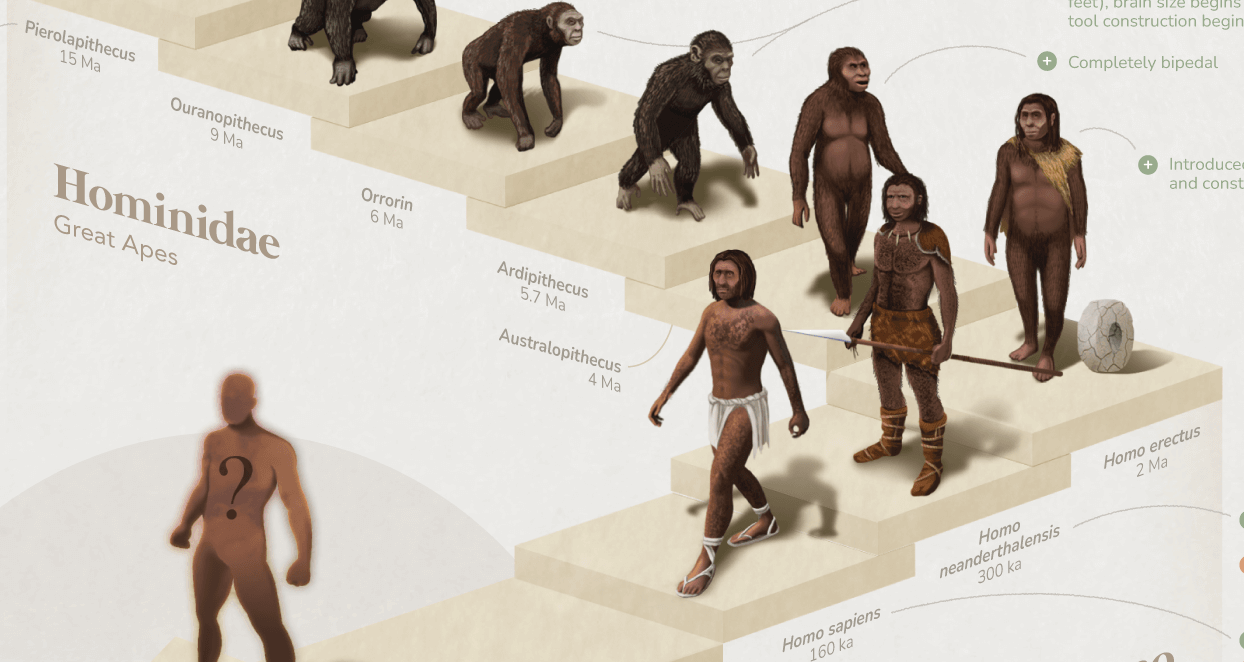
For most of human history, Homo sapiens lived in isolation. The world was vast, movement was slow, and survival was fragile. Encounters between different clans were rare—and when they occurred, they were often violent ⚔️. There were no shared laws, no global norms, no mechanisms for peaceful resolution.
The chance of a sapien from the Indian subcontinent meeting another from the American continent was virtually zero 🌎❌. Even within the Indian landmass in historical times, interactions between the southern and northern regions—or between neighboring ecological zones—were limited by geography, climate, and the absence of organized transportation 🏞️.
Trade and the First Bridges 🌉
Then came two quiet revolutionaries: trade and transportation.
Trade demanded movement. Movement expanded trade. Each fed the other in a reinforcing loop 🔁.
As traders reached the edges of known markets, they pushed further outward. Goods moved first—then people followed 👣. With movement came exposure. With exposure came change. Lifestyles evolved, aspirations expanded, and societies slowly reconfigured themselves in pursuit of better lives 🌾➡️🏙️.
This cycle repeated itself—again and again—over centuries.
The Present Moment: Fear Meets Scale 🌐
Now, in 2025, humanity finds itself more connected than ever before. Never in history have sapiens interacted at this scale, speed, and density ⚡. Migration—across nations and within them—has become a defining feature of modern life.
And with it, an ancient instinct awakens: “Who belongs, and who does not?” 🧠
Political ideologies often ignite this instinct, turning uncertainty into division for short-term gain 🗳️.
But scale matters.
How Far We Have Come 🕊️
Ten thousand years ago, when one clan met another, the outcome was often annihilation. One group disappeared. The other barely survived. Casualties were total 💀.
Today, such encounters do not end in mass slaughter. Borders may exist, rules may apply, visas may be required—but lives are not extinguished simply for crossing paths 📄✋. No country officially sanctions killing people of another nationality. On these principles, and many others, the world has already reached remarkable consensus.
From an eagle’s-eye view 🦅, this is an extraordinary achievement.
Toward Inevitable Normalisation 🌅
The mingling of sapiens—across cultures, languages, and identities—will normalize. “Soon” may mean years or decades ⏳, but the direction is unmistakable. This is not a detour in history; it is its continuation.
The choice before us is simple, though not easy:
Fear or fraternity.
Division or dignity.
Walls or bridges 🧱➡️🌉.
To uphold brotherhood today is not naïve idealism. It is alignment with the deepest arc of human evolution—one that has slowly, painfully, but decisively moved from extinction toward coexistence 🤍.